
Driving Under the Influence of Cannabis Before and After Partial Legalization
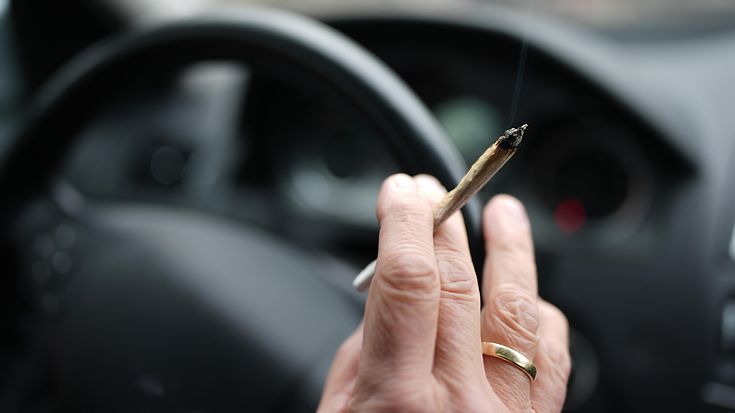
The German Insurers Accident Research (UDV) has examined how cannabis users approach the issue of road traffic—and whether their behavior has changed since the introduction of the Cannabis Act (CanG).
- Publications on the topic
Following the partial legalization of cannabis in Germany, a statutory THC limit of 3.5 ng/ml of blood serum was introduced for driving a motor vehicle. Above this level, the legislature considers it no longer safe to drive a motor vehicle (analogous to the 0.5 per mille limit for alcohol). In addition, there is a complete ban on driving under the influence of cannabis for novice drivers still in their probationary period and for persons under the age of 21.
The consumption and driving behaviors of cannabis users before and after the partial legalization of cannabis were examined using an online survey. A total of 4,933 respondents participated in the first survey (January through mid-March 2024), and 3,144 respondents participated in the second survey (February/March 2026). Individuals aged 18 and older who had used cannabis within the past twelve months and who currently held or had previously held a driver’s license were eligible to participate.
The sample was characterized by a high affinity to consume cannabis. Over 80 percent of respondents used cannabis at least once a week, about half of them used it (almost) daily. While the sample was not representative, it does allow for an in-depth examination of a group that is particularly relevant to traffic safety.
Legal Limit Has Little Effect on the Driving Behavior of Cannabis Users
In the past 12 months, one in five respondents reported having driven a vehicle shortly after using cannabis (one in four in 2024); in the past month, one in seven did so shortly after use (one in six in 2024). In particular, people who are accustomed to cannabis and use it regularly—often even daily—frequently drive afterward. The new legal situation is well known (88 percent), but about one in three respondents does not care. And only Distractionone in two respondents observes that others are complying with it.
Misperceptions About Fitness to Drive
More than two-thirds of those who drive no later than two hours after using cannabis feel that it has little effect on their driving ability (70 percent). Some justify their driving under influence by citing medical reasons (35 percent). Over one-fifth of respondents who reported using prescribed cannabis considered themselves fit to drive, regardless of the dose (22 percent). The proportion of respondents who reported using cannabis at least partially for medical purposes - 71 percent - is nearly twice as high as it was in 2024 (36 percent). Apparently, easier access via telemedicine platforms is contributing to this trend.
THC Limit Offers Only Limited Practical Guidance
44 percent of respondents stated that the current regulations regarding the THC limit, mixed use with alcohol, and the consequences of repeated violations tend to cause uncertainty rather than provide clarity. This is hardly surprising, given that cannabis has a complex mechanism of action and is metabolized differently in the body than alcohol, making it hard to tell when the THC limit is reached. There are still no self-tests available that can detect a THC concentration of 3.5 nanograms in the body. As a result, people under the influence of a drug that impairs their perception and cognitive function are expected to assess for themselves whether or not they can drive safely.
Key recommendations
- Significantly more education about the effects of cannabis, how it is metabolized by the body, and the limits of self-assessment.
- Rapid tests for cannabis users and the police that can detect a THC concentration of 3.5 nanograms/ml of blood serum.
- More roadside checks, for which the police must be equipped with the necessary technology and personnel. Alcohol- and drug-related offenses are what are known as “checkpoint offenses,” which are often uncovered only during police checks. The survey also showed that the frequency of roadside checks in Germany is low: About 82 percent of respondents said they had not been stopped by the police in the past 12 months. The number of unreported cases is high.