
The impact of 30 km/h sections on road safety on main urban roads
Every year, many people continue to be killed or seriously injured in road accidents in urban areas. Since 2010 in particular, only minor improvements have been achieved. One approach to further improving road safety is the introduction of 30 km/h speed limits on sections of main urban roads. In a study conducted by the German Insurers Accident Research (UDV), sections of main urban roads with 30 km/h speed limits were examined in detail.
- Publication on the topic
What aspects of 30 km/h sections did the UDV investigate?
In addition to a literature review, the study focused on a detailed analysis of 42 main urban roads with sections subject to a 30 km/h speed limit. The analysis covered both the sections where the speed limit had been reduced and the adjacent sections where the 50 km/h speed limit remained unchanged.
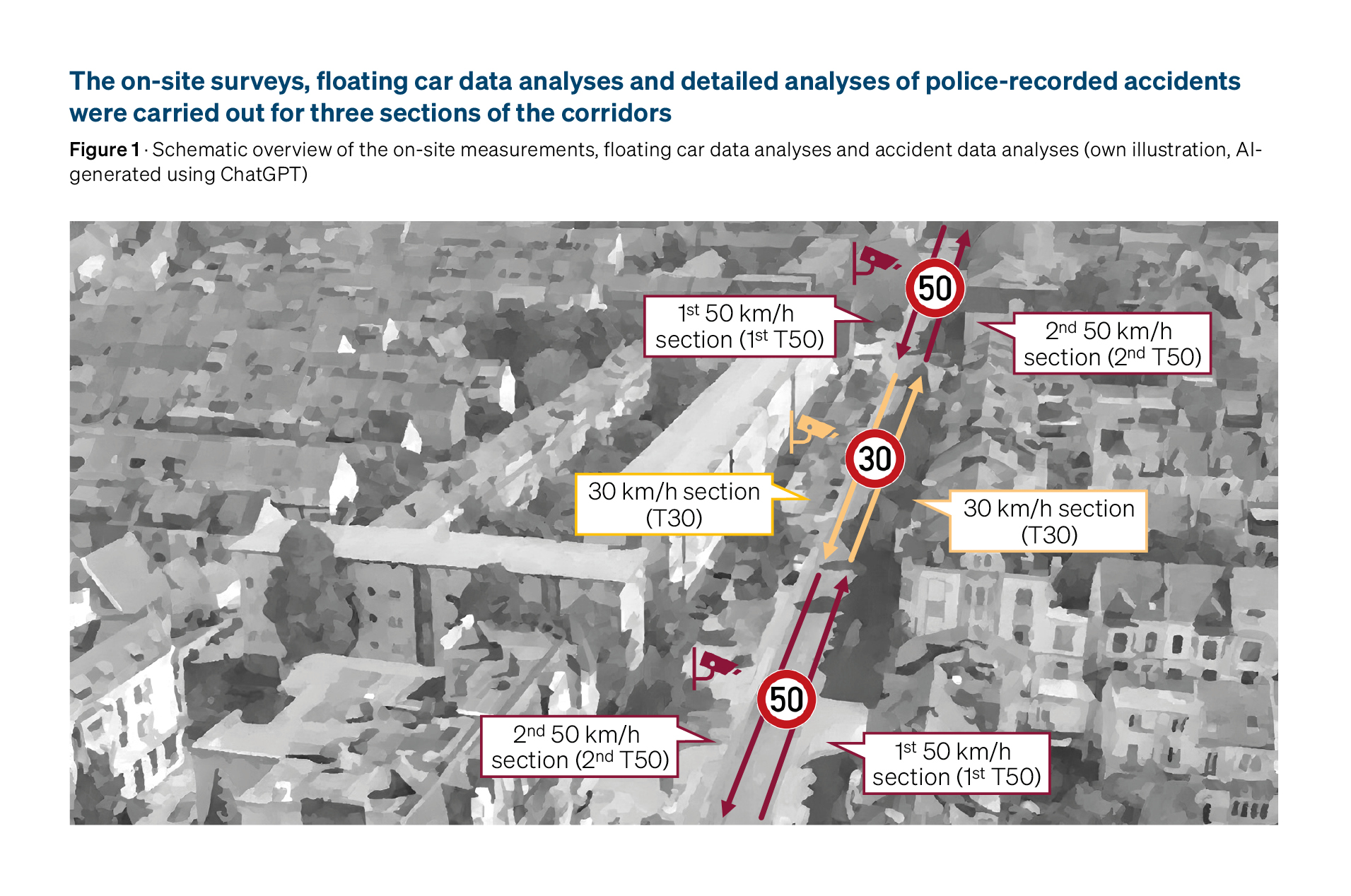
In addition to measuring speeds in all three sections, floating car data and road accidents before and after the introduction of the 30 km/h speed limit were analysed. In total, the UDV was able to analyse 2,428 accidents resulting in personal injury, 419 of which occurred in the sections where the 30 km/h speed limit had been introduced. When assessing changes in accident numbers, a further distinction was made between all accidents and those that could be directly influenced by a speed limit. These speed-limit-relevant accidents (1,342 accidents resulting in personal injury in total, including 288 in the 30 km/h sections) included only cases involving at least one moving motor vehicle travelling along the road in question. Accidents on intersecting roads, single-bicycle accidents, collisions between pedestrians and cyclists, dooring accidents and other types of accidents that could not be directly addressed by a speed limit were excluded. The study also examined various road design characteristics and their potential influence on accident trends. These included, among other factors, the number of motor vehicle lanes in each direction, whether trams operate in mixed traffic and the density of junctions.
How did speeds change on the 30 km/h sections?
Speed measurements show that compliance with 30 km/h speed limits on sections of main urban roads is limited. Only a quarter of motor vehicle drivers complied with the limit. Half of all drivers drove faster than 36 km/h, while 15 per cent even exceeded 47 km/h. A comparison of floating car data also shows that the introduction of 30 km/h speed limits on these sections resulted in only minor speed reductions. The average speed over the length of the sections fell only slightly, from 38 to 36 km/h. The reduction was somewhat greater on longer sections than on shorter ones.
What effect did the 30 km/h speed limit sections have on accidents?
Since large and complex intersections are predominantly located in the 50 km/h sections, the overall number of accidents is higher there than in the 30 km/h sections. Nevertheless, the positive effect of introducing 30 km/h speed limits is already evident in the overall accident figures. In the 30 km/h sections, accidents resulting in personal injury decreased by 25 per cent. In the adjacent 50 km/h sections, the decrease was significantly smaller, at around 10 per cent.
When considering only accidents resulting in personal injury that can be directly addressed by a speed limit, the reductions are even more pronounced. Before the introduction of the 30 km/h speed limits, 57.3 accidents resulting in personal injury per year were recorded in the sections where the speed limit was subsequently reduced. Following the introduction of the 30 km/h speed limits, this figure fell to 39.2, representing a reduction of approximately one third. No comparably strong effect was observed in the adjacent sections where the speed limit remained unchanged at 50 km/h. The reduction in serious accidents was particularly pronounced. Overall, accidents resulting in serious injuries or fatalities decreased by 57 per cent. Of this reduction, 42 percentage points were attributable to accidents that can be directly influenced by a speed limit, while 14 percentage points were attributable to accidents that cannot be directly influenced by a speed limit. When considering only serious accidents that can be influenced by a speed limit, a reduction of 57 per cent was also observed. In contrast, the adjacent 50 km/h sections showed only slight reductions or even increases in serious accidents.
Most of the accidents on the roads examined were collisions between motor vehicles. The number of these accidents decreased significantly. Before the introduction of the lower speed limits, 41.3 accidents involving only motor vehicles and resulting in personal injury were recorded per year in the sections of all 42 roads subsequently designated as 30 km/h sections. Following the introduction of the 30 km/h speed limits, this figure fell to just 24.7. The significant reduction in serious accidents was observed not only in accidents involving only motor vehicles, but also in the less frequent accidents involving pedestrians and cyclists. Serious accidents involving only motor vehicles decreased from 5.7 to 2.7 per year, serious accidents involving pedestrians from 3.0 to 1.3, and serious accidents involving cyclists from 4.7 to 1.5. Similar trends were observed among accidents that can be directly addressed by a speed limit.
Which types of roads benefit most from 30 km/h speed limit sections?
Improvements in road safety were observed primarily on roads with more complex traffic conditions. Roads with two lanes in each direction showed a particularly high number of accidents, which decreased significantly following the introduction of 30 km/h speed limit sections. Roads with one lane in each direction also showed slight improvements, although their accident records had generally been unremarkable even before the speed limit was reduced. Significant improvements were also observed in other complex traffic environments, such as roads where trams share lanes with other vehicles.
What recommendations can be derived from the study?
The introduction of 30 km/h speed limit sections on the main roads examined contributed to improved road safety. Serious accidents in particular decreased significantly. No comparable trend was observed in the adjacent sections where the speed limit remained unchanged at 50 km/h. Based on the findings of the study, the following recommendations are made regarding the use of 30 km/h speed limit sections on main roads:
- Cities and municipalities should make targeted use of the existing options for introducing 30 km/h speed limits under the applicable road traffic regulations wherever traffic conditions require them. As a general rule, speed limits should therefore be reduced to 30 km/h in the immediate vicinity of sensitive facilities and in other locations where the applicable regulations allow. It is recommended that the introduction of 30 km/h speed limit sections be considered particularly on roads with more complex traffic conditions, where particularly significant improvements in road safety can be achieved.
- Where 30 km/h speed limits are introduced and there is flexibility regarding the length of the sections, very short sections should generally be avoided in favour of longer ones. Longer sections lead to slightly greater reductions in vehicle speeds and more pronounced safety improvements.
- Introducing a 30 km/h speed limit section alone is not sufficient. Increased speed enforcement is required to improve compliance with the speed limit.
- 30 km/h speed limit sections on main roads can only complement, not replace, infrastructure-based road safety measures. Other measures, such as ensuring good visibility, providing safe pedestrian crossings at locations that meet actual demand, and implementing conflict-free traffic signal control at intersections, are equally necessary.
What aspects should be considered when assessing the transferability of the study findings?
The following aspects should be taken into account regarding the detailed analysis of accidents and the recommendations based on it:
- Many factors contribute to improved road safety. The effects observed on the roads examined therefore cannot be attributed solely to the introduction of 30 km/h speed limit sections, even when considering only accidents that can be directly influenced by a speed limit.
- The study examined only individual 30 km/h speed limit sections on main roads. The findings therefore cannot be directly applied to a city-wide introduction of a 30 km/h speed limit.
- The detailed analysis included only 30 km/h sections on roads where the speed limit had previously been 50 km/h throughout. The findings therefore cannot be directly applied to sections introduced to close gaps between existing 30 km/h sections or to extend existing 30 km/h speed limits.
- The assessment of infrastructure-related conditions was limited to accident scenarios that can be directly addressed by a reduced speed limit.